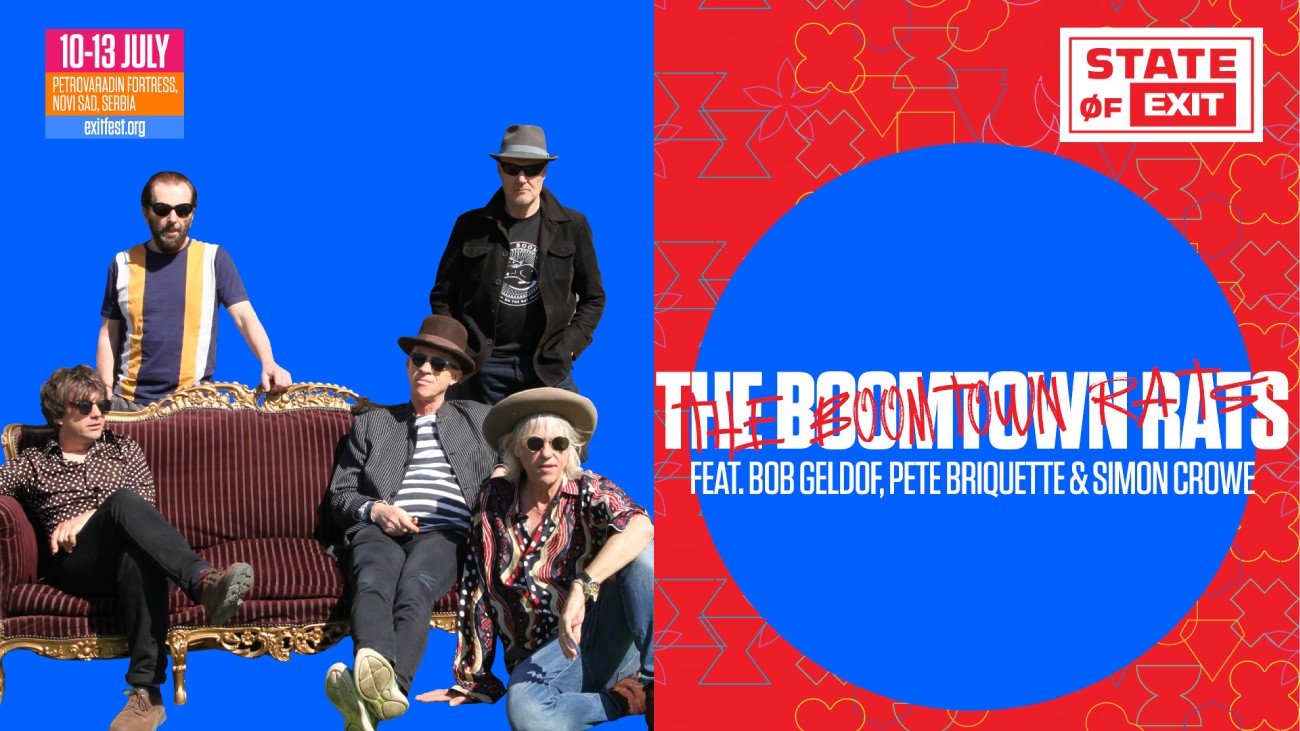
Sir Robert “Bob” Geldof, Irish musician, activist, controversial antihero, and the man who gave rock’n’roll a new purpose at the end of the 20th century. And joining him are none other than his band The Boomtown Rats, the group that pushed the boundaries of punk rock and new wave back in the ’70s, when they decided to raise their voices against apathy, war, injustice, and dull Mondays.
EXIT has always known how to blend fun with a message, dance with change, hedonism with responsibility. And this year, with the appearance of Bob Geldof at the Petrovaradin Fortress, that spirit returns in full force. Because this isn’t just another concert – it’s a reminder of a time when music had the power to move the world. Literally.
From Dublin to Live Aid: How the “Rats” Made History
The Boomtown Rats formed in Ireland in 1975 as a punk response to the social depression and deeply provincial mindset of the time (unimaginable in Ireland 50 years later). Even then, Bob Geldof was more than just a lead – he was the megaphone of a generation that refused to stay silent. Singles like “Rat Trap” and especially the anthemic “I Don’t Like Mondays“ became global hits, but also proof that rebellion could be turned into a chorus. ‚
Their sound wasn’t the raw punk energy of the Sex Pistols, nor the cold new wave of Joy Division – The Boomtown Rats were gritty, cynical, and infectiously melodic all at once. The guitars snarled, the lyrics dissected the world around them, and Geldof, with a charisma falling somewhere between a dandy, a preacher, and a street philosopher, became a “quasi-political” leader without a party. Their performance of “Rat Trap” on Top of the Pops is legendary: opening with them tearing up pictures of John Travolta, symbolically cutting ties with the much-despised disco – the #1 enemy of punk and new wave at the time, and Geldof “playing saxophone” by blowing into a candlestick holder – complete with real, lit candles. Geldof was a kind of proto-Jarvis Cocker and Pulp figure of that era.
Do They Know It’s Christmas?
But the real explosion came in 1984–85, when Bob Geldof, shocked by scenes of famine in Ethiopia, gathered the crème de la crème of British music for the “Band Aid” project and the iconic song “Do They Know It’s Christmas?“ Younger generations may not remember, but in the early 1980s, a massive famine struck due to regime change and civil war. Unlike previous instances of mass starvation, this time, televisions were in nearly every home, broadcasting everything live, to the horror of the world. The British army was airdropping food, but it wasn’t enough.
Geldof saw a BBC report by Michael Buerk and was completely paralysed with horror, and the feeling stayed with him. When he ran into Scottish musician Midge Ure (of Ultravox) in a studio by chance, the idea for a “charity single” struck him. He immediately called up Spandau Ballet, Duran Duran… and the rest was history. Everyone showed up, no egos involved, and what we got was one of the most significant singles in music history, a song that tops the charts every Christmas season. Americans joined in with “We Are the World,” and Yugoslavians with “Za milion godina,” a track we still hear often today. Financially, the whole world got involved: Soviets, East Germans, West Germans, Poles, French… Yet Bob felt even that wasn’t enough. He believed we could do better. And bigger.
And then, on July 13, 1985, Live Aid happened.
Live Aid: The Day the World Stopped and Listened to Music
It was a concert that united the world in real time, before the internet could do so. Wembley Stadium in London and JFK Stadium in Philadelphia, connected via satellite, broadcast live to more than 150 countries, reaching around 1.5 billion people. Queen played (in a now-legendary performance later immortalized in the Freddie Mercury biopic), along with David Bowie, U2, The Who, Led Zeppelin, Madonna, Bob Dylan, and behind it all stood one man – the person who spoke, shouted, negotiated, and charmed his way into raising as much money as possible for famine-stricken Africa.
Though never a stadium-filling solo artist, Geldof became the face of an era – rebellious, engaged, relentless. He went down in history as Sir Bob (technically incorrect, but lovingly used as a nickname), a knight without armour but with a guitar and a voice that didn’t tolerate indifference.
This summer, he’s coming to EXIT – and it’s not just a performance, it’s a call to awaken. A reminder that songs once meant more than algorithm-generated TikTok hits with ten-second dance routines.
The Boomtown Rats: A Return of “Rats” That Still Bite
Although The Boomtown Rats disbanded in 1986 (Geldof would go on to have a successful solo career in the early ’90s with songs like “I Don’t Mind”), he brought the band back together in 2013 to remind the world that “rats” never truly go away. Today, the band is a mix of veteran energy and an undying struggle against boredom and apathy. Songs like “Looking After Number One,” “Banana Republic,” and of course “I Don’t Like Mondays” still sound fresh, perhaps because the world, 40 years later, keeps repeating the same mistakes. And The Boomtown Rats have always been a band that sings about exactly that – raw, uncensored, and unapologetic.
Geldof doesn’t take the stage to impress – he comes to shock, to spark something, to light a torch within the audience. And we have no doubt he’ll do exactly that at EXIT. Because while some show up just to be seen, he shows up to make you see. And what could be more fitting for this age of unrest and awakening, when the world is doing everything it can to shatter our illusions of normalcy?
The World 40 Years Later: Is Another Live Aid Still Possible?
As Live Aid marks its 40th anniversary, the question arises – could something like that happen again today? Could the world stop for a single song? Would Billie Eilish and Bad Bunny record a duet for Ethiopia? Or have we lost that spirit of unity for good? (Ethiopia is once again at war and starving, sadly, just like neighbouring Sudan and South Sudan, and musicians are staying completely silent!)
Bob Geldof certainly doesn’t believe we’re beyond saving. In interviews, he still rails against greed, stupidity, and climate inaction. The Boomtown Rats are, in that sense, his loudspeaker for the messages that social media algorithms often suppress. EXIT, a festival with soul, is the perfect place for that message. Because while the world burns and the algorithms “laugh,” a man is arriving at the Petrovaradin Fortress who once said: “This is not a concert. This is a war against indifference.”
I Don’t Like Mondays, but I Love Exits.
We all know Geldof doesn’t like Mondays. But if there’s one place where he might learn to love a Thursday, it’s EXIT. A festival born out of protest, born from a fight for freedom, and one that continues to gather thousands of people each year who believe in music’s power to change the world. The Boomtown Rats’ performance isn’t just a concert – it’s a history lesson, a living demonstration of how art and activism can go hand in hand. And Bob Geldof is not just a musician. He’s a witness to an era, a living legend, and someone who will show at EXIT that “old rats” can still bite. Fiercely.
He hasn’t forgotten who he is – not now, not ever. As much a fighter for justice as he is a musician. Just this March, through EXIT’s social media channels, he voiced support for the students of Serbia in their fight for a better tomorrow, saying: “We’re proud to be playing at the EXIT Festival on July 10, on your 25th anniversary, one of the last remaining independent festivals. It’s ironic because it is the 40th year of Live Aid, and we are so impressed by what the students of Serbia have been doing in their fight for justice, just like Live Aid was attempting to do 40 years ago. So, of course, we stand with the students of Serbia. We stand with the EXIT festival. We’ve always played music that articulates freedom, change, and justice. And that’s what we’ll be doing on July 10 at the EXIT Festival. We stand with you.” True to his Irish stubbornness, he couldn’t stay silent, and after the pressures the festival has faced, we expect he’ll have even more to say once he’s on stage.
Join him – not just for the nostalgia, but for a future worth building. And make it loud. Thankfully, EXIT doesn’t happen on a Monday, so we won’t have to worry about Bob’s mood during the show.
Author: Žikica Milošević