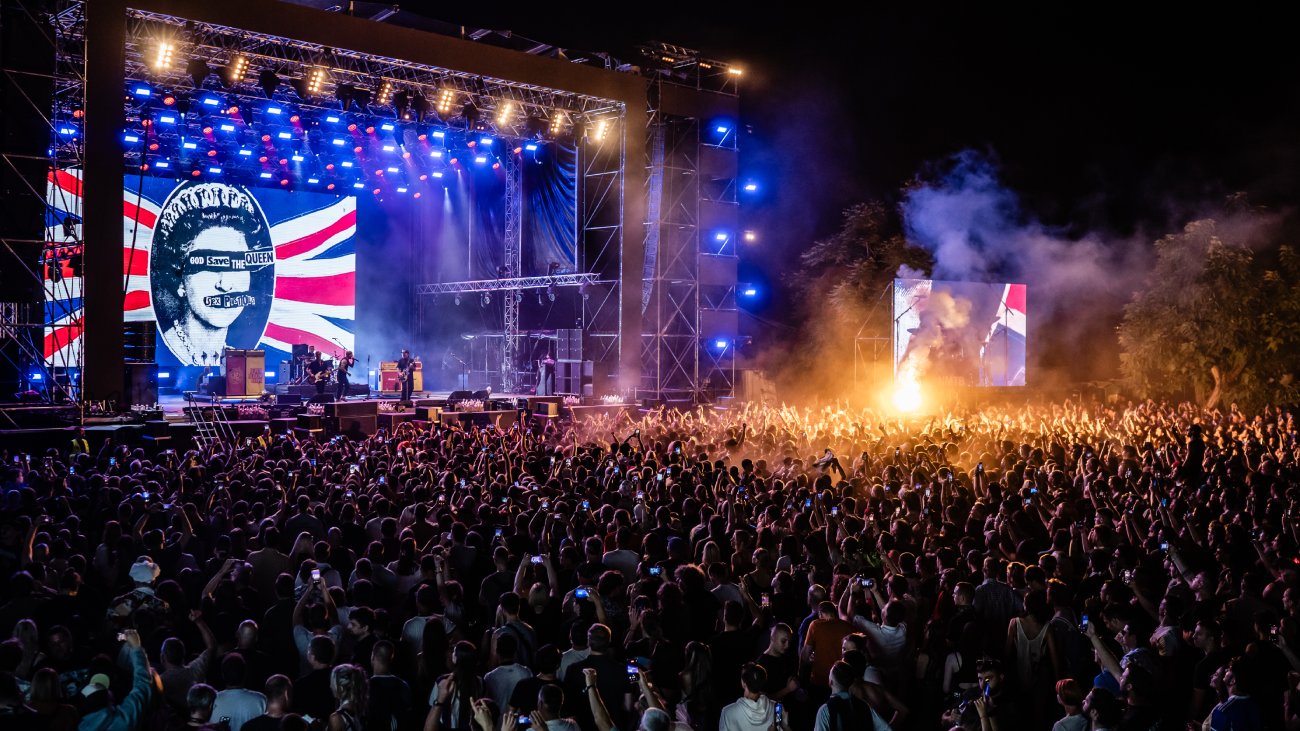
One album. Just one. “Never Mind the Bollocks, Here’s the Sex Pistols.” A title like a slap in the face, a rebellion against any form of seriousness. They already performed at Exit Festival back in 2008, during that “(Gypsy-)punk Exit” which featured a wave of similar acts, and the Pistols were set to “crown” the whole thing on Sunday. That was the Filthy Lucre tour, and Johnny Rotten was still on the mic. It wasn’t bad, but it wasn’t glorious either, as any punk would tell you. This time, things are entirely different. A much younger Frank Carter, and incomparably more energetic, has taken Johnny’s place in a change that many initially described as blasphemous. Punks being against blasphemy? That’s a contradiction in itself. Because punk is blasphemy.
From the very first song, “Holiday in the Sun,” it was clear that things would take on a local political flavor, as the other band members joined in on backing vocals in Serbian: “Pumpaj, pumpaj!” The song itself is a protest against “bread and circuses,” the dumbing down of the British working class through package deals to Benidorm while everything at home was coming apart at the seams. Simply put, in the ’70s, Britain was going through a structural crisis, and young people couldn’t take being obedient anymore. Their hope had been taken away, their economy gutted, and they invented punk as an insult, both musically and stylistically, as a way to say “No.” “We’re not the old boys from the ’40s, going off to war for you only to become your obedient servants again in peacetime,” they said in their own way.
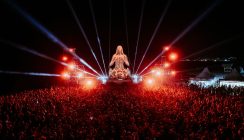
Frank Carter immediately proves he has boundless energy and an incredible connection with the audience – he jumps off the stage and persuades the most loyal fans to do something typically punk, yelling, “Let’s all run in a circle!” He’s in the crowd, surrounded by people; he’s one of us. The legendary “Pretty Vacant” kicks in – pretty vacant, and I don’t care. Frank climbs back onto the Main Stage platform, clearly thrilled with the crowd, as shown by the smile on his otherwise deadpan face.
They go on to perform all the songs from “Never Mind the Bollocks” – in the crowd, there’s the old guard, those born shortly after these songs came out, and even people barely in their twenties. Striking are the young women with perfect fashion-punk styling, jumping along with their glam-looking friends, ones you’d never peg as fans of this aesthetic and sound. Rebellion and refusal to accept injustice transcend generations. Because even though it’s often said that Britain “colonized the whole world,” people forget that its rulers first colonized their own population, inflicting the most harm on their own citizens. Oscar Wilde once said, “The East End is the problem of slavery, and we solve it by entertaining the slaves.” Well, the slaves were no longer amused, and to the horror of the ruling class, they invented punk aesthetics, punk poetry, and punk melodies.
Frank Carter picks up a cardboard sign from the crowd that says, “Give me an autograph,” and with a smile, carries it to every band member for their signature. Carter is the charismatic driver of this new incarnation of the band. He convinced the Pistols not only that replacing Rotten wasn’t impossible but that someone else could be just as good, or, as heretical voices whisper, “even better.” Paul Cook on drums, Glen Matlock on bass, and Steve Jones on guitar now have the energy they’d been missing. They say they sound more like a band now than they did in 1977, when they were “a group of individuals on stage.” In fact, Carter seems “more Rotten than Rotten,” and whatever the reason for the original lineup’s fallout, it seems paradoxical to be replaced by someone who’s “more you than you are.”
I look around. The punks no longer aim to shock, but the place is full of young people who uphold the values of punk that actually matter. No more safety pins in mouths, no more swastika shirts meant to horrify the establishment. Now it’s all filtered through fashion statements. After all, the Pistols themselves were a fashion project by Vivienne Westwood and the band’s manager, Malcolm McLaren, who used the band’s aesthetic to promote clothing and accessories from their London boutique, “Sex.” Aesthetics and ethics are directly linked, with one flowing from the other.
Rotten is gone, but a much more muscular and equally wild-eyed Carter energetically jumps around the stage, singing his heart out to “God Save the Queen/King” with the iconic visuals of the Queen behind the band. No future, and England’s dreaming – the words hit us and cut our hearts like blades. Substitute your own country into any of the songs in place of England, and there’s your connection – that’s the genius of the Pistols. “No Fun,” a cover of The Stooges, whose frontman Iggy Pop is dubbed “the Godfather of Punk,” sounds just as fresh as it did in 1977 or 1969.
Frank, by the way, is neither Rotten (who reportedly dropped out of the picture after Danny Boyle’s series “Pistol” saw the light of day and made Johnny angry) nor Sid Vicious, but he still managed to perform Frank Sinatra’s classic “My Way” in a way that paid tribute to Sid’s vocal version. Then came the introductions and a heartfelt reflection on the band’s history. Frank mentioned that he was the only one who hadn’t been at the 2008 concert, but was told that EXIT was an amazing place to play. During the introductions, the band even weaves the now-iconic “Pumpaj!” into their melodies – their engagement is local, too. They know exactly where they are.
It all wraps up with “Anarchy in the UK” in a storm of ecstatic energy. I finally understand the story about a sparsely attended Sex Pistols show at Manchester’s Lesser Free Trade Hall in June 1976, where “18 and a half people” (in actual fact about 40) were in the crowd, and every single one of them was so overtaken by the band’s energy that they went on to form a legendary band of their own. Without the Pistols, there would be no modern scene. Their seed has long since sprouted into “children,” “grandchildren,” and “great-grandchildren.”
Because they were among the first to say: “I refuse.” And that refusal is powerful enough to topple an (unjust) world.
Author: Žikica Milošević