Petrovaradin, but it feels like even the twelfth time would be just as wild, packed, euphoric, dance-fueled, and primal to the bone.
They say Lepa Brena is an eternal icon in Bulgaria – everyone remembers, as if it happened yesterday, her concert nearly 40 years ago in Sofia when she became the first foreign star to visit the brotherly country “behind the Iron Curtain” a place hungry for spectacle, for love, for belonging to the world. Fast forward to 1995, just a few years later, and we see FR Yugoslavia, and Serbia as its main constituent, behind a new Iron Curtain: the curtain of sanctions. And then, a new band from Essex emerges, defiantly saying “we don’t care about sanctions,” and comes to Belgrade, to a country once again hungry for spectacle, love, and global connection. Thirty years later, that bond and love between Serbia and The Prodigy remain just as strong. As Sandra Bullock put it in Speed, these are relationships forged in stressful circumstances. They’re full of adrenaline and a kind of subconscious loyalty that feels like a vow. A vow we made to The Prodigy, and they made to us.
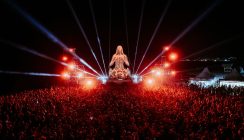
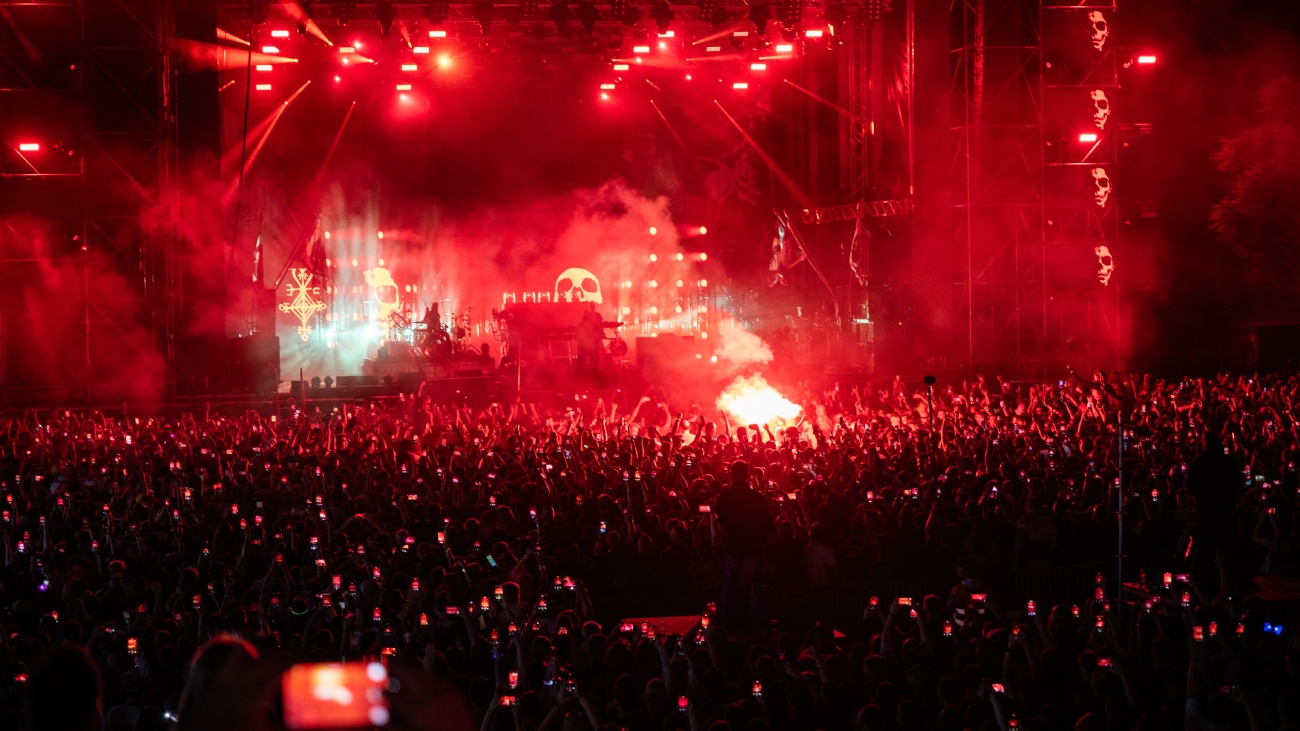
The stage turned red as the moon rose over the Tesla Universe arena. Flags flanking the venue gave the impression that one was entering a medieval court. Then Maxim, the ruler of that court, greeted the crowd. “Voodoo People” thundered through the speakers, and Maxim, who himself comes from a kind of voodoo lineage (his parents are from Jamaica), began his “sermon”. Maybe today’s youth don’t go to churches to hear traditional sermons, but the new churches are right here, and priests like Maxim preach in their own way. They are trusted. They are loved.
It’s interesting how Britain is a country where, whenever one cultural trend reigns supreme, another, completely opposite one quietly brews under the surface like a xenomorph growing in society’s chest, only to burst out and take over. While Britpop dominated the 1990s charts and hearts, a new counter-trend was being forged – not with words, but with rhythm and sound. The Chemical Brothers, Fatboy Slim, Moby across the Atlantic, and of course, The Prodigy, built a new movement, not without words, but with mantras, repeated over and over. “The Fat of the Land” dropped 28 years and a few days ago (time flies!) and still feels as fresh as ever. It’s one of those albums that shaped music history, which, like Dorian Gray, simply doesn’t age. The same is true of “Nevermind” by Nirvana, “Disintegration” by The Cure, or “What’s the Story, Morning Glory” by Oasis – these albums permanently changed the world.
Drums have never been the go-to melodic leader in music. Usually, when you hum a melody, it’s the vocals, bassline, synth, or guitar. But with The Prodigy, more often than not, it’s the drums. You hum the rhythm. Not many bands pulled this off – Adam and the Ants with its two full drum kits in the early ’80s comes to mind. There’s no doubt the guys from The Prodigy grew up listening to Adam and his Ants. Guitars and drums are accentuated by synths in a beautiful noise that could be from Heaven or Hell, depending on who’s listening. Perhaps only the legendary The KLF created music this way – dominating early ’90s charts before ending their career by burning a million pounds as an act. Where The KLF stopped, The Prodigy continued. Now, younger artists like Master Peace cite The Prodigy as influences, mixing them with Arctic Monkeys to create a bold new sound. The Prodigy has long lived on through the next generation. And that’s priceless.
“Omen” with its chime-like synth got the crowd on its feet. Thousands kept arriving at the stage, entranced. Then came a deeply emotional rendition of “Firestarter” where Maxim didn’t sing – he just stood still, a shadow. The camera zoomed in on him, the stage screens showing the same image. Maxim, unmoving, paid tribute to Keith Flint, whose recorded voice occasionally screamed “Firestarter!” It wasn’t sixteen minutes of silence like the night before – it was a few minutes of noise, but we all had lumps in our throats. Keith, a tormented soul, still hovers among us. It feels like we’re still trying to talk to him, futilely begging: “Don’t go, we love you!” In vain.
Maxim now shoulders a heavy burden – instead of partnering with Keith, he must carry every vocal line himself. He does this brilliantly and never tries to overshadow Keith’s memory – he pays homage in every song. And then, of course, came perhaps the most iconic bass line in music history. A song that premiered right here in Serbia – “Breathe.” It’s still hard to believe someone actually wrote this song. One night, in autumn 1996, it aired on the old Channel 3, our window to the world at the time. From that moment, we never saw our friends the same way again. They fell into two camps: those who loved “Breathe” whom we respected, and those who thought dirty water, bugs, and growling vocals were to be avoided. The Prodigy redefined “cool” that November. And we knew that anyone who called this “a song from Hell” was simply a dinosaur.
“Smack My Bitch Up” was the cherry on top. Thankfully, Maxim knew he was in a place where political correctness held no sway, especially not in the last eight months, and didn’t change the lyrics to the sanitized “Change my pitch up” as he sometimes does post-2023. And then it hit us, looking at the crowd’s faces, a cross-generational mix from 16 to 66 – The Prodigy had achieved something fundamental. They gathered us around their rhythm, just like ancient tribes danced in a trance around fire. The Prodigy hit you in the gut and the heart. They built a story of a primordial community – we were a tribe dancing joyfully around the flames, unified in our tribal experience.
They were our priests – once again. And we were the ones the Force had descended upon. The beating heart of Serbia stood at the Main Stage this night. And the feeling was so. damn. good. Like no other.
Author: Žikica Milošević